MikroMES vs Traditional MES: Why Small Shops Need a Different Approach
Traditional MES is built for large, regulated, IT-resourced operations. For most small shops, that power is a liability. An honest comparison of where each approach wins - and how to tell which one you actually need.

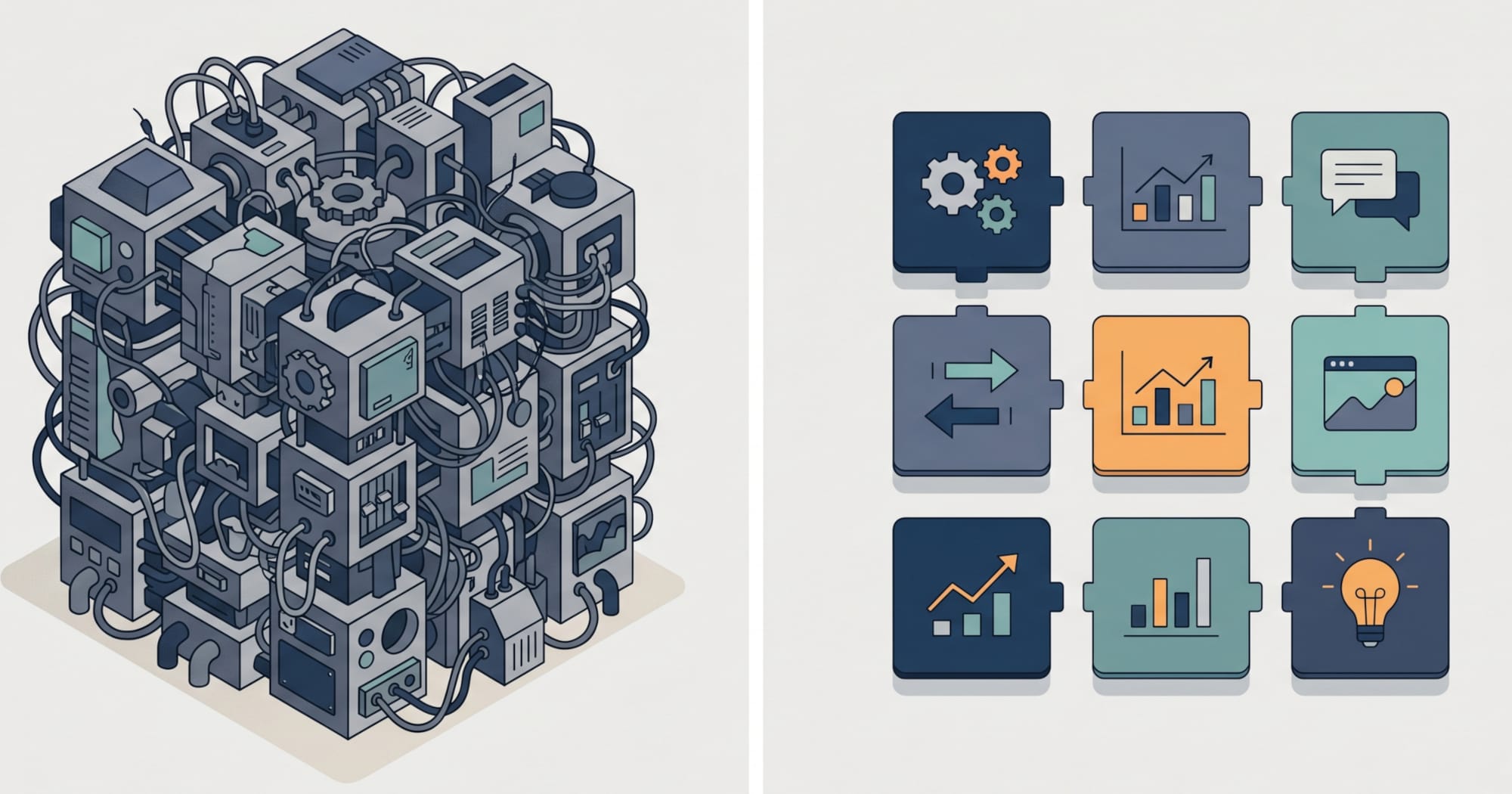
TL;DR: Traditional MES platforms are powerful, comprehensive, and built for large manufacturers with IT departments and 12-month implementation budgets. For a small shop, that power becomes a liability - you pay for complexity you'll never use. This post is an honest comparison: where a traditional MES genuinely wins, where a modular approach like MikroMES wins, and how to tell which one your operation actually needs. No strawmen, no competitor-bashing - just the real trade-offs.
The Question Behind the Question
When a small manufacturer starts looking at MES software, the real question is rarely "which MES is best?" It's "do I need a full MES at all, or is there a lighter way to solve the specific problems hurting me right now?"
That's the right question. And the honest answer is: it depends on what you're trying to fix, how big you are, and how much complexity you can absorb.
Traditional MES platforms aren't bad software. For the right operation, they're transformative. But "the right operation" usually has characteristics most small shops don't: a dedicated IT team, regulatory traceability requirements, hundreds of operators, and the budget and patience for a year-long implementation.
If that's not you, forcing a traditional MES onto your floor is like buying a 40-ton press to drive a finishing nail. This post will help you tell the difference.
What "Traditional MES" Actually Means
A traditional Manufacturing Execution System is a comprehensive, integrated platform designed to manage the entire production process. The classic MESA model defines 11 core functions - resource allocation, scheduling, dispatching, document control, data collection, labor management, quality, process management, maintenance, traceability, and performance analysis.
The defining characteristic is integration. Everything is connected: the quality module talks to the scheduling module talks to the ERP integration talks to the traceability engine. That integration is the source of both the power and the problem.
The power: a fully implemented MES gives you end-to-end visibility and control, with complete genealogy from raw material to finished good.
The problem: you have to implement, configure, integrate, and maintain all of it - even the 80% you don't need - and you have to keep it running. That's the complexity tax.
The Complexity Tax
Here's what a traditional MES implementation typically demands of a small manufacturer:
Time. 12 to 18 months from kickoff to a working system, in many cases. Requirements gathering, configuration, integration with existing systems, testing, user acceptance, training, and phased rollout.
Money. Implementation costs frequently run into six figures and beyond once you include licensing, integration work, hardware, consultants, and internal staff time. The license is often the smallest line item.
People. Traditional MES assumes you have IT staff to host or manage the system, integrate it with your ERP and machines, and maintain it through upgrades. Most small shops don't have a spare IT team sitting idle.
Adoption risk. This is the silent killer. A comprehensive system with complex menus is a system operators resist. When the interface is hard, operators enter dirty data or avoid the system entirely - and a fully-featured MES full of bad data is worse than a simple tool full of good data.
For a large enterprise, these costs are absorbed by scale. The system runs across thousands of operators and dozens of lines, and the per-unit cost of all that capability is reasonable. For a 60-person shop, the same costs land on a much smaller base - and most of the capability goes unused.
$50/month vs. $25,000+ implementation
The MES built for factories that can't afford to wait.
See the full head-to-head comparison: time to value, real costs, hardware, training, and AI - modular SaaS vs. legacy MES. Built for the SME factory that needs results this week, not this fiscal year. Snap-together modules, free to start.
✓ Free forever for 5 stations · ✓ Deploy in 60 seconds · ✓ No IT required
Where Traditional MES Genuinely Wins
This is the part most "alternative" pitches skip. There are real situations where a traditional MES is the right call, and pretending otherwise would be dishonest. Choose a full MES when:
You have regulatory traceability requirements. If you're in medical devices, pharmaceuticals, aerospace, or regulated food production, and you need complete, audited genealogy from raw material to finished unit, a traditional MES is built for exactly this. The traceability and compliance modules aren't optional bloat for you - they're the requirement.
You run complex, multi-stage processes that demand tight integration. If your production involves dozens of interdependent stages where scheduling, quality, and dispatching genuinely need to operate as one integrated system, the integration that makes traditional MES heavy is the integration you need.
You're large enough to absorb the complexity. With hundreds of operators, dedicated IT, and the budget for a proper implementation, the complexity tax becomes affordable, and the comprehensive capability pays off.
You need deep ERP and automation integration. If your operation depends on real-time, bidirectional data flow with SCADA, PLCs, and an enterprise ERP across the whole plant, traditional MES is designed for that level of integration.
If you recognize your operation in these descriptions, take the traditional MES route seriously. The rest of this post is about everyone else - which is most small manufacturers.
The Modular Alternative: How MikroMES Approaches It
MikroMES starts from a different premise: most small manufacturers don't have one big "implement an MES" problem. They have two or three specific, costly, daily problems - and they need those solved this week, not next year.
So instead of one monolithic platform, MikroMES is a set of focused apps that snap together. You deploy only what addresses your actual pain:
- SnapTrack - machine downtime tracking. Log a stoppage in 3 seconds with a single tap.
- Pace - real-time production pacing. Target vs. actual on any display.
- BinTrack - bin-level inventory visibility on high-value items, without a full WMS.
- RequestRepair - QR-code maintenance ticketing that bridges operators and maintenance.
And across all of them, FabAI - a built-in AI agent you can ask, in plain language, "what's my top downtime cause this week?" or "which critical bins are below threshold?" and get an answer instantly.
The design philosophy is captured in one line from the founders: if an operator needs more than 60 seconds of training, the tool is too complex. That's the opposite of the traditional MES assumption.
The Honest Comparison
Here's how the two approaches actually stack up on the dimensions that matter to a small manufacturer:
| Dimension | Traditional MES | MikroMES (Modular) |
|---|---|---|
| Time to deploy | 12–18 months | Minutes to days |
| Upfront cost | Six figures and up | Free tier, then monthly per module |
| IT requirement | Dedicated IT team | None - cloud-native |
| Scope | All 11 MES functions | Only the modules you pick |
| Operator training | Extensive | Under 60 seconds per tool |
| Data quality risk | High (complex UI → dirty data) | Low (frictionless capture) |
| Traceability/genealogy | Full, audited | Not the focus |
| Best fit | Large, regulated, IT-resourced | Small/mid, visibility-focused |
| AI | Add-on or absent | FabAI built in from day one |
Notice that the traditional MES column isn't all negatives. The full traceability and comprehensive scope are genuine strengths - for the operations that need them. The point isn't that one is better. It's that they're built for different operations.
How to Tell Which One You Need
Run your operation through these questions honestly:
Do you have hard regulatory traceability requirements? If yes - full genealogy, audited, from raw material to shipped unit - lean toward traditional MES. If no, that's a major point toward modular.
Do you have IT staff who can own a major system implementation and maintenance? If no, the modular, cloud-native approach removes a dependency you can't satisfy anyway.
What's actually hurting you right now? If you can name your top two or three problems - "we don't know why the line stops," "we keep running out of materials," "maintenance takes forever to respond" - a modular approach lets you solve exactly those, immediately. If your answer is "we need comprehensive end-to-end production management," that leans traditional.
How much time do you have? If you need results this quarter, a 12-month implementation isn't a solution to your current problem. If you're building a multi-year manufacturing IT foundation, the timeline matters less.
Can your operators absorb a complex system? Be honest about adoption. The best system on paper is worthless if your team won't use it. If simplicity is critical to adoption on your floor, that's a strong signal toward the modular approach.
For most small and mid-sized manufacturers, the answers point the same direction: you don't need the full platform. You need two or three specific problems solved, fast, without an IT project. That's the gap the modular approach fills.
You Don't Have to Choose Forever
One more thing that often gets lost in the "platform vs. apps" framing: it's not a permanent, irreversible decision.
Starting with a modular tool doesn't lock you out of a fuller system later. You can deploy SnapTrack on your worst line next week, prove the value with clean data, and expand module by module as you grow. If you eventually reach the scale and complexity where a full MES makes sense, you'll make that decision with far better data about your own operation than you have today - because you'll have been capturing it all along.
The modular approach is also designed to coexist, not replace. It works alongside your existing ERP and software rather than demanding you rip everything out. That's a fundamentally lower-risk way to start than betting a year and six figures on a platform before you've proven it fits your floor.
Start small. Solve a real problem. Expand on evidence. That sequence works for almost every small manufacturer - and it's the opposite of how traditional MES is sold.
Frequently Asked Questions
What is the difference between MES and a modular manufacturing app? A traditional MES is a single comprehensive platform covering all production functions - scheduling, quality, traceability, maintenance, and more - deeply integrated and implemented as one system. A modular manufacturing app like MikroMES solves specific problems (downtime, inventory, pacing, maintenance) as independent tools you deploy individually. The MES is built for end-to-end control at scale; the modular approach is built for solving specific pains fast.
Is a traditional MES ever the right choice for a small manufacturer? Yes. If you have hard regulatory traceability requirements (medical devices, pharma, aerospace, regulated food), complex multi-stage processes that require tight integration, or you're large enough to have dedicated IT and absorb a major implementation, a traditional MES can be the right call. The modular approach is best when your needs are specific and visibility-focused rather than comprehensive.
How much does a traditional MES cost vs a modular alternative? Traditional MES implementations frequently run into six figures and beyond when you include licensing, integration, hardware, consultants, and internal staff time, over a 12–18 month timeline. Modular alternatives like MikroMES start with a free tier (up to 5 stations per module) and scale with monthly per-module pricing, deployable in minutes with no implementation project.
Do I need an IT department to use MikroMES? No. MikroMES is cloud-native with zero infrastructure to maintain - no servers, no integration project, no IT overhead. You sign up and deploy the same day. This is a deliberate contrast with traditional MES, which typically assumes dedicated IT staff to host, integrate, and maintain the system.
Can I start with a modular tool and move to a full MES later? Yes. Starting modular doesn't lock you out of anything. You can deploy one app on one line, prove the value, and expand as you grow. If you eventually reach the scale where a full MES makes sense, you'll make that decision with far better data about your own operation. The modular approach also coexists with your existing ERP and software rather than replacing it.
What is FabAI and how does it compare to AI in traditional MES? FabAI is MikroMES's built-in AI agent, available across every module from day one. You ask questions in natural language - "what's my top downtime cause this week?" - and get instant answers, insights, and actions. In traditional MES, AI is typically an add-on, a separate analytics layer, or absent entirely. With the modular approach, the AI is included and operates on clean, normalized data captured at the source.
The Bottom Line
The choice between a traditional MES and a modular approach isn't about which software is better in the abstract. It's about which one fits your operation.
If you're large, regulated, IT-resourced, and need comprehensive end-to-end control with full traceability - a traditional MES is built for you, and you should take it seriously.
If you're a small or mid-sized manufacturer with two or three specific, costly problems, no spare IT team, and a need for results this quarter rather than next year - the complexity of a traditional MES works against you, and a modular approach will get you further, faster, for far less.
Most small shops fall squarely in the second category. They don't need a bigger platform. They need better apps, deployed today, on the problems that are actually costing them money.
See the MikroMES suite - deploy what you need, free tier, no IT project required.
$50/month vs. $25,000+ implementation
The MES built for factories that can't afford to wait.
See the full head-to-head comparison: time to value, real costs, hardware, training, and AI - modular SaaS vs. legacy MES. Built for the SME factory that needs results this week, not this fiscal year. Snap-together modules, free to start.
✓ Free forever for 5 stations · ✓ Deploy in 60 seconds · ✓ No IT required
Guy Mizrahi is the co-founder of MikroMES and has 20+ years of experience in MES and manufacturing operations.