7 Signs Your Shop Floor Needs a Maintenance Ticketing System
Most maintenance downtime isn't repair time - it's communication time: finding someone, relaying the problem, waiting for a response. Here are 7 signs your floor has outgrown phone-tag maintenance, and what to do about it.

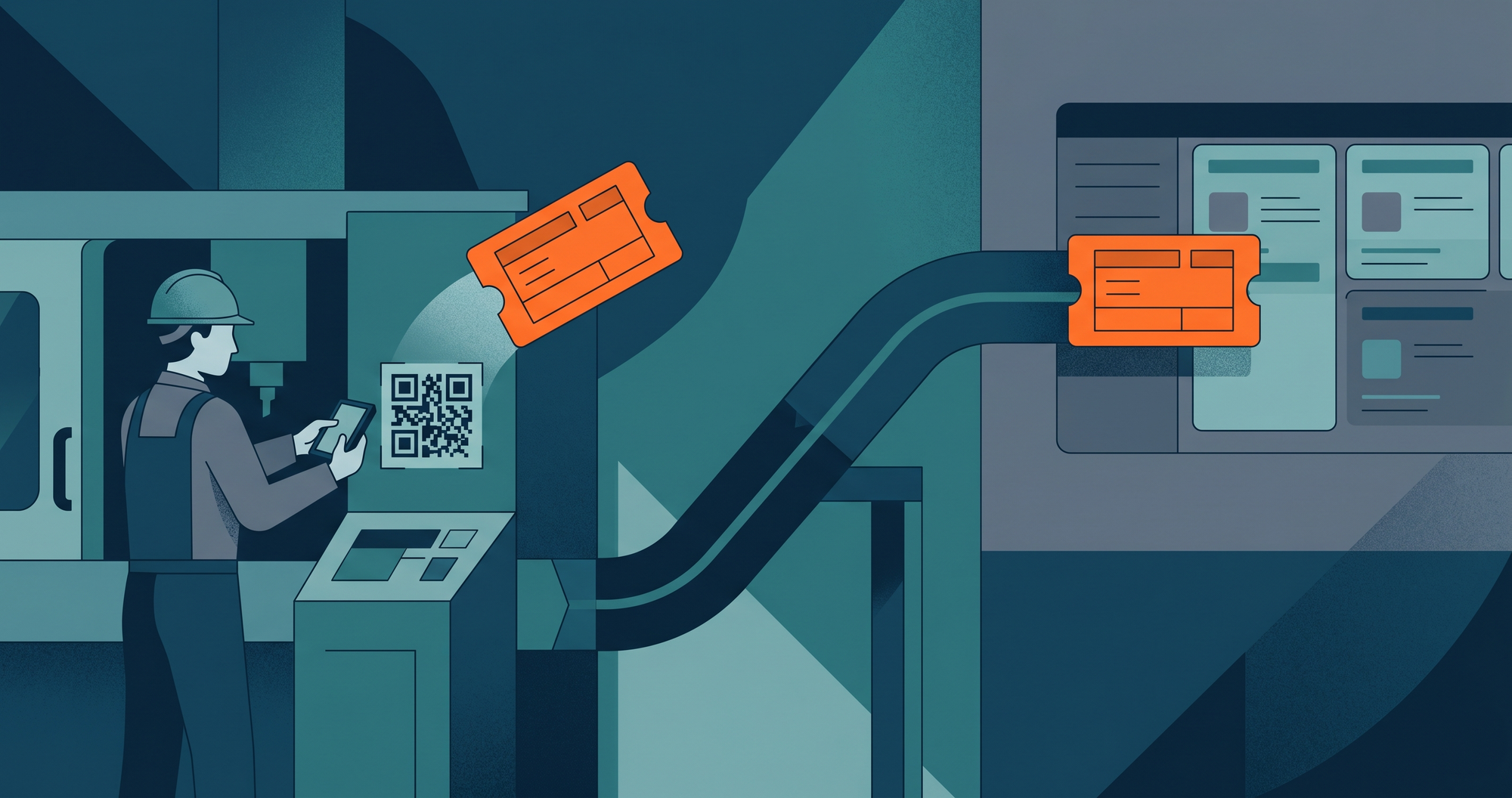
TL;DR: When a machine breaks down, the clock starts - and on most small shop floors, most of the "downtime" that follows isn't repair time. It's communication time: finding someone, explaining the problem, waiting for maintenance to show up. A maintenance ticketing system closes that gap by turning verbal, walk-around requests into structured digital tickets. Here are seven signs your floor has outgrown phone-tag maintenance - and what to do about it.
The Hidden Half of Downtime
Here's something most plant managers underestimate: when a machine goes down, the time spent actually fixing it is often the smaller part of the total stoppage.
The bigger part is everything that happens before the technician's hands touch the machine. The operator notices the problem and looks for a supervisor. The supervisor tries to reach maintenance. Maintenance is on the far side of the building, mid-task, or on break. A message gets relayed, maybe garbled. By the time the right person arrives with the right information, far more time has elapsed than the repair itself takes.
This is the communication gap, and it's where a huge amount of recoverable downtime hides. A 10-minute fix becomes a 50-minute stoppage - not because the repair was hard, but because the request took 40 minutes to land.
A maintenance ticketing system exists to collapse that gap. Instead of verbal relays and phone tag, an operator raises a structured ticket the instant something breaks - location, machine, issue, urgency, all captured at once - and the maintenance team sees it immediately, prioritized, with everything they need to respond.
If you're not sure whether your floor needs one, here are the seven signs.
Sign 1: "I Called Maintenance an Hour Ago"
If this sentence is part of your shop floor's daily vocabulary, you have a maintenance communication problem.
The phrase signals a specific failure: the request was made, but it disappeared into a void. Nobody knows if maintenance received it, where it sits in their queue, or when someone's coming. The operator is left guessing, the line is down, and the only recourse is to chase the request again - which itself takes time away from production.
A ticketing system eliminates the void. When a request becomes a tracked ticket, there's no "did they get it?" The ticket exists, it's visible, it has a status. The operator can see it was received and where it stands. That single change removes one of the most frustrating and costly patterns on the floor.
Sign 2: Maintenance Requests Travel by Word of Mouth
On a lot of floors, the "system" for reporting a problem is finding a person and telling them. The operator tells the supervisor, the supervisor tells the maintenance lead, the maintenance lead tells a technician.
Every handoff in that chain loses information. "The press is making a weird noise" becomes "something's wrong with the press" becomes "go check the press." The technician arrives without knowing what they're walking into, hasn't brought the right parts, and has to diagnose from scratch - adding another trip and more downtime.
Structured tickets carry the same complete information to everyone. Machine, location, issue type, description, urgency - captured once, at the source, by the person who actually saw the problem. Nothing degrades in the relay because there is no relay.
Sign 3: You Can't Tell Which Machines Break Most
Ask yourself: which machine generated the most maintenance requests last month? Which failure type comes up most often? Which line eats the most maintenance response time?
If you can't answer with data, you're flying blind on maintenance - and that means you're stuck in purely reactive mode, fixing things as they break with no ability to get ahead of them.
A ticketing system makes every request a data point. Over a few weeks, patterns emerge: this machine accounts for a third of all tickets, this failure type recurs every few days, this line consistently waits longest for response. That data is the foundation for moving from reactive to preventive maintenance - you can't prevent what you've never measured.
Sign 4: Small Problems Become Big Ones
A minor issue flagged immediately is a quick fix. The same issue left because reporting it was too much hassle becomes a breakdown.
This is one of the most expensive consequences of high-friction maintenance reporting. When raising a request means tracking down a supervisor and explaining the problem, operators do a quiet cost-benefit calculation: is this worth the hassle? For small issues - a minor leak, an odd noise, a part showing wear - the answer is often "I'll mention it later." Later becomes never, and the small problem grows into a stoppage.
When reporting takes seconds - a quick scan and a tap - that calculation flips. Operators flag the small things because flagging is effortless. You catch problems while they're still small, which is the entire goal of good maintenance.
Deploy in minutes, not months
Solve your biggest shop floor problem this week.
MikroMES gives you modular, AI-powered apps for downtime, inventory, production pacing, and maintenance - with FabAI, your built-in agent, surfacing the insights you'd otherwise miss. Pick only what you need. Free tier forever, no hardware, no IT project.
✓ Free tier forever · ✓ Deploy in minutes · ✓ No IT department needed
Sign 5: Your Maintenance Team Works by Whoever Shouts Loudest
Without a system, maintenance prioritization defaults to social dynamics. The most persistent operator, the loudest supervisor, the problem closest to someone's desk - these get attention, not necessarily the most critical issues.
This means a genuinely urgent problem can wait while a minor one gets handled first, simply because the minor one had a more insistent advocate. It's nobody's fault - it's the absence of a system to surface what actually matters.
A ticketing system lets requests carry priority and lets the maintenance team work a real queue. Urgent tickets surface to the top. The team works by importance, not by volume of complaints. And managers can see the whole queue, which means they can spot when something critical is waiting too long and intervene.
Sign 6: You Have No Record of What Was Fixed
When maintenance happens through verbal requests and informal fixes, there's no history. Six months later, when the same machine fails the same way, nobody remembers it happened before, what was done, or whether it's a recurring issue that needs a real solution rather than another patch.
That missing history is costly. Recurring problems get treated as one-offs forever. You can't see that a machine has been "fixed" five times for the same fault - which would tell you it needs replacement or overhaul, not a sixth patch. You have no maintenance record for warranty, compliance, or planning purposes.
Every ticket, resolved and logged, builds that history automatically. The maintenance record becomes a searchable asset: what broke, when, what fixed it, how often. That history is where smart maintenance decisions come from.
Sign 7: Production and Maintenance Blame Each Other
When communication is informal and untracked, accountability gets murky - and murky accountability breeds friction between teams. Production says they reported the problem; maintenance says they never got a clear request. Both are probably telling the truth as they experienced it, because the "request" was a hallway conversation nobody can reconstruct.
This friction is corrosive. It turns two teams that should be working together into two teams pointing fingers, and it makes every breakdown a little more adversarial than it needs to be.
A ticketing system replaces blame with a record. The ticket shows when the issue was reported, when it was acknowledged, when it was resolved. There's no argument about what happened because it's all there. That clarity doesn't just speed up repairs - it repairs the relationship between the people doing production and the people keeping production running.
What a Maintenance Ticketing System Actually Looks Like
If several of those signs sound familiar, the fix is more approachable than you might expect. A modern maintenance ticketing system for a small shop floor doesn't require a complex CMMS implementation or an IT project. The essentials:
Instant reporting at the machine. A QR code at each machine that an operator scans to raise a ticket. No walking to find someone, no logging into anything, no app to download. See the problem, scan, tap, done - in seconds.
Structured information, captured once. The ticket captures machine, location, issue type, and urgency at the source, from the person who saw the problem. Complete information, no degradation through relays.
A real-time queue for maintenance. The maintenance team sees incoming tickets immediately, prioritized, with everything they need. They work a queue by importance, not by who shouted loudest.
Status visibility for everyone. Operators see their ticket was received and where it stands. No more "did they get it?" No more chasing.
An automatic history. Every ticket, logged and searchable, builds the maintenance record that turns reactive firefighting into data-driven decisions.
This is exactly what RequestRepair, the maintenance module in the MikroMES suite, was built to do - QR-driven work tickets that bridge the gap between production and maintenance, with documented response-time improvements around 50%. And because it's part of MikroMES, FabAI can answer questions across the data: "which machine has generated the most maintenance tickets this month, and what's our average response time?" - turning your maintenance history into answers, instantly.
How Maintenance Ticketing Connects to the Rest of the Floor
Maintenance doesn't happen in isolation. The reason a line stops and the time it takes to get it running again are two halves of the same downtime problem.
This is why maintenance ticketing pairs naturally with downtime tracking. Downtime tracking captures that the line stopped and why; maintenance ticketing manages getting it running again - and the response-time data from your tickets tells you exactly how much of your downtime is repair time versus communication time. Together they give you the full picture of a stoppage, from the moment it happens to the moment production resumes.
That full picture is what feeds better OEE. The Availability component of OEE is dragged down by every minute a machine sits idle - including all that communication time before the repair even starts. Cut the response lag, and you directly recover Availability you were losing without ever seeing it.
Frequently Asked Questions
What is a maintenance ticketing system? A maintenance ticketing system turns maintenance requests into structured, tracked digital tickets instead of verbal or informal reports. When something breaks, an operator raises a ticket capturing the machine, location, issue, and urgency; the maintenance team receives it immediately in a prioritized queue; and everyone can see the ticket's status. It replaces phone tag and word-of-mouth requests with a clear, recorded process.
How does a maintenance ticketing system reduce downtime? Much of the downtime after a breakdown isn't repair time - it's communication time spent finding someone, relaying the problem, and waiting for maintenance to arrive. A ticketing system collapses that gap by delivering a complete, structured request to the maintenance team the instant a problem is reported. Tools like RequestRepair show response-time improvements around 50% by removing the communication lag.
Do small manufacturers need a CMMS for maintenance? Not necessarily. A full CMMS (Computerized Maintenance Management System) is powerful but often heavy for a small shop's core need, which is fast, clear communication between operators and maintenance. A lightweight maintenance ticketing tool delivers the essential value - instant structured requests, a prioritized queue, and an automatic history - without the cost and complexity of a full CMMS implementation.
How do operators report maintenance issues with a ticketing system? With a modern system, an operator scans a QR code at the machine, selects the issue type and urgency, and submits - all in a few seconds, on any device, with no login or app download. The request becomes a tracked ticket the maintenance team sees immediately, complete with machine, location, and problem details captured at the source.
What's the difference between maintenance ticketing and downtime tracking? Downtime tracking records that a machine stopped and why, building the data to find and eliminate the top causes of lost time. Maintenance ticketing manages getting the machine running again - routing the repair request and tracking response. They're complementary: tracking captures the stoppage, ticketing manages the fix, and together they reveal how much of your downtime is repair time versus communication lag.
How does maintenance ticketing improve OEE? The Availability component of OEE is reduced by every minute a machine sits idle, including the communication time before a repair even begins. By delivering structured requests instantly and letting maintenance work a prioritized queue, a ticketing system cuts that response lag - directly recovering Availability, and therefore OEE, that was being lost in the gap between breakdown and repair.
The Bottom Line
Most maintenance downtime on a small shop floor isn't a maintenance problem. It's a communication problem wearing a maintenance costume. The repairs themselves are usually fast; it's the finding, relaying, waiting, and chasing that drains the hours.
If you recognized your floor in even a few of these seven signs - the disappeared requests, the word-of-mouth relays, the missing history, the team friction - the fix isn't more technicians or faster repairs. It's closing the gap between "something broke" and "the right person is on it with the right information."
A QR code at every machine and a structured ticket in seconds does exactly that. Catch the small problems early, route the urgent ones first, build the history that makes you smarter over time - and turn the most adversarial part of the floor into one that actually works together.
Deploy in minutes, not months
Solve your biggest shop floor problem this week.
MikroMES gives you modular, AI-powered apps for downtime, inventory, production pacing, and maintenance - with FabAI, your built-in agent, surfacing the insights you'd otherwise miss. Pick only what you need. Free tier forever, no hardware, no IT project.
✓ Free tier forever · ✓ Deploy in minutes · ✓ No IT department needed
Guy Mizrahi is the co-founder of MikroMES and has 20+ years of experience in MES and manufacturing operations.