Why Your ERP Isn't Enough for the Shop Floor (The WMS-MES Gap Explained)
Your ERP runs the business, your WMS runs the warehouse - but neither lives on the production floor. The gap between them is where most production problems are born. Here's what it is and how to close it.

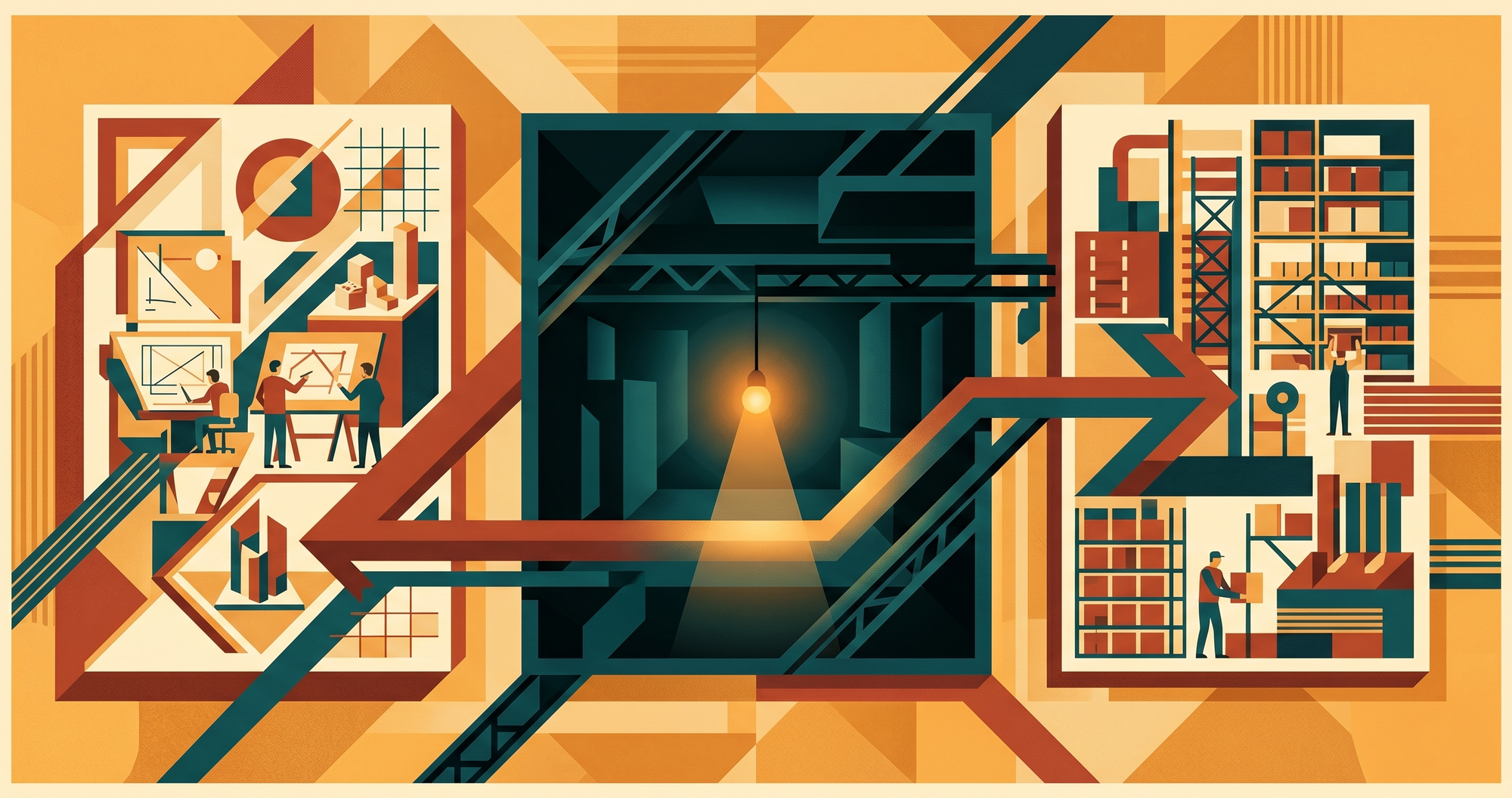
TL;DR: Your ERP runs your business and your WMS runs your warehouse - but neither one actually lives on the production floor. Between the warehouse shelf and the finished product sits a gap that no enterprise system was designed to own, and it's where most production problems are born. This post explains what the WMS-MES gap is, why your ERP can't close it no matter how much you spend, and what small manufacturers actually need to bridge it - without buying a second enterprise platform.
The System That Isn't There
Most manufacturers I've worked with can draw their software stack on a whiteboard in about ten seconds. ERP at the top - finance, purchasing, planning. A WMS or inventory module managing the warehouse. Maybe a quality system, maybe an accounting package, maybe a spreadsheet or two holding it all together.
Then I ask a question that usually produces a long silence: "What system knows what's actually happening on your production floor, right now, in real time?"
The honest answer, for most small and mid-sized manufacturers, is: none of them. The ERP knows what was planned. The WMS knows what's in the warehouse. But the floor itself - where the work actually happens, where materials become product, where the plan meets reality - is a blind spot. There's a system-shaped hole right in the middle of the operation.
After two decades implementing these systems from the buyer's side, I've come to believe this gap is the single most underestimated problem in small manufacturing. Not because the systems are bad, but because everyone assumes one of them covers the floor. None of them do.
What ERP Actually Does (And Doesn't)
Let's be precise, because "the ERP should handle that" is the assumption that keeps this gap invisible.
An ERP - Enterprise Resource Planning - is a business management system. It's exceptional at what it's built for: financial management, procurement, order management, planning, and the master data that ties a company together. When you need to know what you bought, what you owe, what you've committed to customers, and what the plan says should happen - the ERP is the right tool.
What the ERP is not built for is the real-time, physical reality of the production floor. It runs on transactions and batches. Someone enters a goods receipt; the system updates. A bill of materials says a finished unit consumes four components; the system deducts four components when the unit is reported complete. It's an accounting model of production, and the model assumes everything goes according to plan.
But the floor doesn't run on assumptions. It runs on what physically happened - the substitution an operator made at 2 a.m., the material that was damaged and rescrapped, the job that ran in a different sequence than planned, the stoppage nobody logged. The ERP's model and the floor's reality drift apart the moment the shift starts, and the ERP has no way to see the drift, let alone correct it.
This isn't a flaw in your ERP. It's a category boundary. The ERP was never designed to live on the floor - and no amount of configuration makes a planning system into a real-time execution system.
What WMS Does (And Where It Stops)
The same precision applies to the warehouse side.
A WMS - Warehouse Management System - is genuinely excellent at managing a warehouse: receiving, putaway, storage optimization, pick paths, packing, and shipping. In the enterprise distribution centers I helped run, a good WMS was the difference between chaos and control across hundreds of thousands of SKUs.
But a WMS stops at the warehouse door. Its job is to get the right material staged and ready. What happens after the material leaves the warehouse and enters the production area - that's outside its world. The WMS doesn't know that the staged material is sitting at the wrong end of the line, that an operator pulled extra to cover a problem, or that what's physically at the workstation no longer matches what the warehouse handed off.
So you have two systems, each excellent within its boundary, and a gap between them that neither one owns. The ERP plans down to the floor's edge. The WMS supplies up to the floor's edge. And the floor itself - the most operationally critical part of a manufacturer - sits in the space between.
The Gap, Defined
The WMS-MES gap is the space between "the material is in the warehouse and the plan is in the ERP" and "the product is finished and correct." It's the execution layer - and it's where an MES (Manufacturing Execution System) is supposed to live.
In this gap, the questions that decide whether you're profitable get answered:
- Is the line actually running, or stopped?
- Are we on pace to hit the shift target?
- Did that material actually get consumed where the plan said it would?
- Is the right material at the right station at the right time?
- When something went wrong, what actually happened - and when?
Your ERP can't answer these in real time because it runs on batches and plans. Your WMS can't answer them because they happen past its boundary. These are execution questions, and execution is exactly the layer most small manufacturers have no system for.
That's the gap. And here's why it matters: the gap isn't empty. It's full of activity - it's just full of invisible activity. Every problem that lives in the gap is a problem you can't see, can't measure, and therefore can't fix.
Why "Just Get a Bigger ERP" Doesn't Work
The instinct, when you discover this gap, is to reach for more of what you already have. Add an MES module to the ERP. Buy the manufacturing add-on. Make the big system bigger.
Having watched this play out repeatedly at enterprise scale, I'll tell you where it usually leads. ERP-native manufacturing modules are built to the ERP's worldview - transactional, planning-oriented, designed for the office rather than the floor. They tend to inherit exactly the characteristics that make them wrong for execution: complex interfaces operators won't use, data entry that happens after the fact rather than in real time, and a fundamental assumption that the plan is reality.
The result is a system that technically "covers" the floor on the architecture diagram but doesn't actually capture what's happening on it. Operators avoid the clunky interface, so the data is sparse and late. And sparse, late data about execution is barely better than no data - it gives you the illusion of visibility without the substance.
The gap isn't a missing feature you can bolt onto a planning system. It's a different kind of problem that needs a different kind of tool - one built for the floor first, not adapted to it.
Deploy in minutes, not months
Solve your biggest shop floor problem this week.
MikroMES gives you modular, AI-powered apps for downtime, inventory, production pacing, and maintenance - with FabAI, your built-in agent, surfacing the insights you'd otherwise miss. Pick only what you need. Free tier forever, no hardware, no IT project.
✓ Free tier forever · ✓ Deploy in minutes · ✓ No IT department needed
What Actually Bridges the Gap
Here's the good news, and it's the thing I wish more small manufacturers understood: bridging this gap does not require a second enterprise platform. It requires real-time execution visibility, and that can be lightweight.
What the execution layer actually needs to do:
Capture what physically happens, in real time, at the source. Not reconstructed later from the plan, not entered at end of shift - logged at the moment it happens, on the floor, by the people doing the work. Stoppages, output, material movements, quality events.
Make it frictionless enough that operators actually use it. This is the part enterprise systems get wrong. If capturing an event takes more than a few seconds, it won't happen consistently, and inconsistent data is the whole problem you're trying to solve. The interface has to be built for an operator standing at a machine, not an analyst at a desk.
Coexist with the systems you already have. The execution layer shouldn't replace your ERP or fight your WMS. It should sit between them, filling the gap, feeding clean reality back to the planning systems that need it. Your ERP gets better data; your WMS hands off to something that actually tracks what happens next.
Surface the activity that was previously invisible. Once execution data is captured cleanly, the gap stops being a black box. You can see the stoppages, the pace, the material reality - and with an AI agent like FabAI, you can simply ask: "what's actually happening on line 3 right now?" and get an answer drawn from the floor itself, not from the plan.
This is the role the MikroMES suite is built to play - not another monolithic platform, but lightweight execution apps that live exactly in the gap between your ERP and your floor. BinTrack closes the material side of the seam; downtime, pacing, and maintenance modules close the rest. Each one captures a slice of floor reality that neither your ERP nor your WMS was ever going to see.
The Seam Is the Opportunity
I've spent my career on the warehouse-and-logistics side of this divide, and the lesson that's stuck with me is counterintuitive: the gap between systems isn't a weakness to patch over. It's the highest-leverage place in the entire operation.
Think about it. Your ERP is probably already well-implemented. Your warehouse is probably already managed. Those areas have had decades of software investment and they're largely solved. The execution layer - the gap - is the part nobody has tooled, which means it's the part where there's still enormous value sitting uncaptured.
Every hour of unexplained downtime, every material-driven stoppage, every shift that quietly missed target - they all live in the gap. Close it, and you're not making an already-optimized system marginally better. You're lighting up a part of the operation that was completely dark. That's where the real gains are for a small manufacturer: not in a better ERP, but in finally seeing the floor the ERP was never able to show you.
The supply chain delivers to the edge of the floor. The plan describes the floor. But only an execution layer actually sees the floor. For twenty years I watched companies spend fortunes perfecting the systems on either side of the gap while the gap itself stayed dark. The ones that pulled ahead were the ones that finally put a light in the middle.
Frequently Asked Questions
What is the difference between ERP, WMS, and MES? ERP (Enterprise Resource Planning) manages the business - finance, purchasing, planning, and orders. WMS (Warehouse Management System) manages the warehouse - receiving, storage, picking, and shipping. MES (Manufacturing Execution System) manages the production floor - what's running, what stopped, what was produced, and whether it was correct. ERP plans down to the floor's edge, WMS supplies up to the floor's edge, and MES is the execution layer that covers the floor itself.
Why can't my ERP manage the shop floor? An ERP runs on transactions, batches, and plans - it's an accounting model of production that assumes things go as planned. The production floor runs on real-time physical reality: substitutions, stoppages, damage, resequencing, and events that never match the plan exactly. The ERP has no way to see this drift as it happens. It's a category boundary, not a configuration problem - a planning system can't become a real-time execution system.
What is the WMS-MES gap? The WMS-MES gap is the space between "the material is staged in the warehouse and the plan is in the ERP" and "the product is finished and correct." It's the execution layer of the operation. Your ERP can't see into it because it runs on batches and plans; your WMS can't because the activity happens past the warehouse door. Most production problems are born in this gap precisely because no traditional system owns it.
Do I need an MES if I already have an ERP? For most manufacturers, yes - because the ERP and the MES do fundamentally different jobs. The ERP plans and accounts; the MES captures what actually happens on the floor in real time. An ERP-native manufacturing module rarely closes the gap well, because it inherits the ERP's planning-oriented, after-the-fact design. A lightweight execution layer built for the floor captures the reality the ERP can't see.
Can I bridge the ERP-floor gap without buying another big system? Yes. Bridging the gap requires real-time execution visibility, not a second enterprise platform. Lightweight, modular execution apps capture what physically happens on the floor - stoppages, output, material movements - and coexist with your existing ERP and WMS rather than replacing them. This is far cheaper, faster, and more likely to be adopted than a heavyweight ERP manufacturing module.
How does an execution layer work with my existing ERP and WMS? It sits between them, in the gap. The WMS stages and hands off material; the execution layer tracks what happens to that material on the floor; the ERP receives cleaner, reality-based data back for planning and accounting. Rather than replacing your systems, a good execution layer fills the space neither one covers and feeds better information to both.
The Bottom Line
Your ERP isn't failing you. Neither is your WMS. They're both doing exactly what they were built to do - and what they were built to do stops at the edges of the production floor.
The gap in the middle, the execution layer, is the part of your operation that no traditional system was designed to own. It's where stoppages hide, where the plan drifts from reality, where materials go missing in plain sight. And for most small manufacturers, it's completely dark.
You don't close that gap by spending more on the systems that surround it. You close it by putting a light in the middle - a lightweight execution layer that captures what's actually happening on the floor, in real time, and coexists with everything you already run.
See the floor the ERP can't show you. That's where the next gain is hiding.
Deploy in minutes, not months
Solve your biggest shop floor problem this week.
MikroMES gives you modular, AI-powered apps for downtime, inventory, production pacing, and maintenance - with FabAI, your built-in agent, surfacing the insights you'd otherwise miss. Pick only what you need. Free tier forever, no hardware, no IT project.
✓ Free tier forever · ✓ Deploy in minutes · ✓ No IT department needed
Ruth Sinvani is a co-founder of MikroMES with 20+ years in supply chain and manufacturing operations, including leading a €200M automated distribution center launch.