How Small Manufacturers Can Reduce Waste Without a Lean Consultant
Lean consultants sell a trained eye for waste - but the framework behind it is free. Here are the 7 wastes (TIMWOOD), how to spot each on a small shop floor, and how to start cutting them yourself this week.

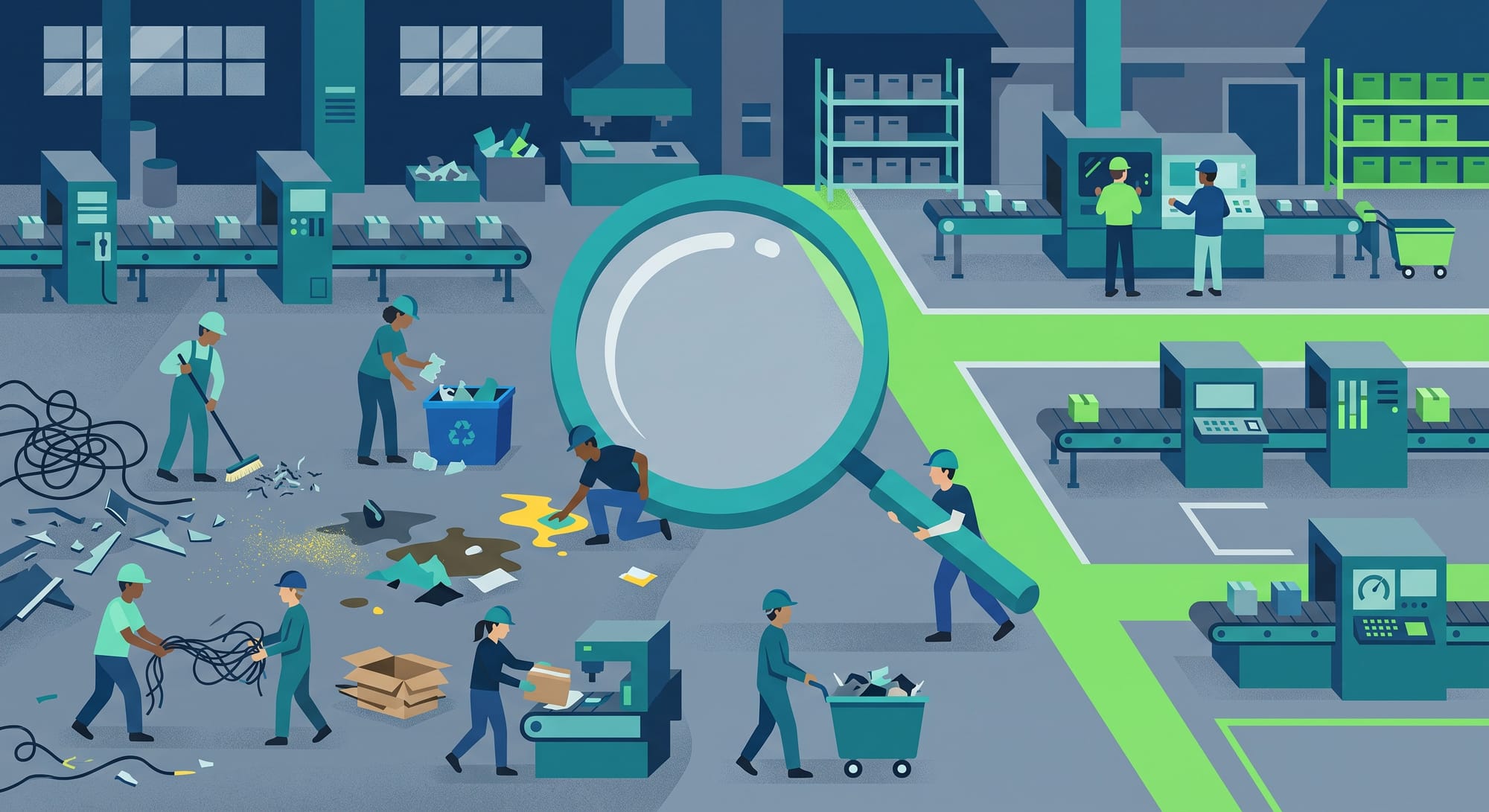
TL;DR: Lean consultants are expensive, and their biggest value - teaching you to see waste - is something you can learn to do yourself. The framework of the 7 wastes (Muda) is simple enough to apply on your own floor this week, and most of the waste it reveals can be attacked with visibility and habit rather than a costly engagement. This post walks through each of the 7 wastes, how to spot it on a small shop floor, and how to start eliminating it - no consultant required.
What a Lean Consultant Actually Sells You
A good lean consultant is genuinely valuable. But it's worth being clear about what you're actually paying for, because most of it is transferable.
What a consultant really brings is a trained eye - the ability to walk onto a floor and see the waste that the people working there every day have stopped noticing. They know the framework, they ask the right questions, and they've seen enough factories to recognize patterns quickly. That's the core of the value.
Here's the thing: the framework they use isn't secret, and it isn't complicated. It's a simple, decades-old model of the seven types of waste. Once you know it, you can start seeing your own floor the way a consultant would - and you're actually at an advantage, because you know your operation far better than any outsider walking in for the first time.
A consultant is worth it for a complex, large-scale transformation. But for a small manufacturer who just wants to stop the obvious bleeding, the honest truth is you can do a great deal of it yourself. It starts with learning to see the seven wastes.
The 7 Wastes (Muda): Your Free Framework
Lean identifies seven classic types of waste - often remembered by the acronym TIMWOOD. Waste is anything that consumes resources without adding value for the customer. Here's each one, translated into what it actually looks like on a small shop floor, and how to start attacking it.
1. Transport - Moving Things That Don't Need Moving
What it is: Unnecessary movement of materials, parts, or products between locations.
On your floor: Material that travels back and forth across the building, components staged far from where they're used, finished parts that get moved to a holding area only to be moved again. Every move costs labor and adds a chance for damage or loss.
How to attack it without a consultant: Walk your material's path (the material flow mapping exercise is exactly this). Every time material moves, ask "does this move add value?" If it's just repositioning, it's transport waste. Shorten the distances, relocate storage closer to point of use, eliminate the double-moves.
2. Inventory - Stock That Sits and Ties Up Cash
What it is: More raw materials, work-in-progress, or finished goods than you actually need right now.
On your floor: Bins overflowing with components "just in case," piles of work-in-progress between stations, finished goods waiting weeks to ship. Excess inventory hides problems, ties up cash, and takes up space.
How to attack it without a consultant: Look for the piles. Where does material accumulate? Those buffers usually exist to cover a problem upstream - a slow changeover, an unreliable supplier, a bottleneck. Get real-time visibility on your actual stock levels so you can safely hold less. Excess inventory is often just a lack of confidence in what you have.
3. Motion - Wasted Movement of People
What it is: Unnecessary movement by operators - walking, reaching, searching.
On your floor: An operator walking to a shared tool across the shop, hunting for a fixture that has no home, reaching awkwardly for parts because the workstation is poorly arranged. Motion waste exhausts your people and slows every cycle.
How to attack it without a consultant: Stand and watch one operator work for 15 minutes. Count the steps, the reaches, the searches. Most motion waste is obvious the moment you actually watch for it. Bring tools and parts closer, give everything a fixed home, arrange the workstation around the natural flow of the work.
4. Waiting - Idle Time When Nothing Is Happening
What it is: People or machines sitting idle, waiting for something.
On your floor: An operator waiting for material to arrive, a machine idle because the previous step isn't done, a whole line stopped waiting for a maintenance response. Waiting is one of the most visible wastes once you look - and one of the most expensive.
How to attack it without a consultant: Track your downtime. When you log why the line stops and for how long, the waiting waste stops being invisible. The patterns point straight to the causes - material delays, slow maintenance response, upstream bottlenecks - and you attack the biggest ones first.
5. Overproduction - Making More or Sooner Than Needed
What it is: Producing more than the customer needs, or earlier than it's needed.
On your floor: Running a big batch because "the machine's already set up," building ahead of demand to keep people busy, making parts that then sit as inventory. Overproduction is often considered the worst waste because it creates other wastes - excess inventory, extra transport, more storage.
How to attack it without a consultant: Produce to actual demand, not to keep machines running. This is where production pacing helps - when your target is tied to real demand (takt), you make what's needed rather than as much as possible. Resist the urge to run big batches just because setup is done; that "efficiency" usually creates more waste than it saves.
6. Overprocessing - Doing More Work Than the Product Requires
What it is: Adding more effort, precision, or steps than the customer actually values.
On your floor: Polishing a surface nobody sees, inspecting the same part three times, tolerances tighter than the application needs, extra paperwork nobody reads. Overprocessing feels like diligence but is pure waste.
How to attack it without a consultant: For each step in your process, ask "does the customer care about this?" If a step adds cost but not value the customer would pay for, question it. This is the hardest waste to see because it often masquerades as quality or thoroughness - but much of it is habit, not requirement.
7. Defects - Work That Has to Be Redone
What it is: Parts that are wrong and must be scrapped or reworked.
On your floor: Rejected parts, rework loops, scrap, customer returns. Defects are doubly expensive - you paid to make the part wrong, then you pay again to fix it or make a replacement, plus the material and the delay.
How to attack it without a consultant: Track your defects and, critically, their causes. Which station, which product, which shift produces the most? Real first-time-through quality data shows you where to focus. Most defects cluster around a few root causes - find those, fix those, and the rework loop shrinks dramatically.
The Pattern: Most Waste Is Invisible Until You Measure It
Read back through the seven wastes and you'll notice something. The reason a consultant can see waste you can't isn't magic - it's that they're looking for it systematically, while you've grown used to it. The waste has become part of the scenery.
The single biggest thing you can do to reduce waste without a consultant is make the waste visible - because invisible waste never gets fixed. And most shop floor waste is invisible precisely because it's never measured:
- Waiting is invisible until you track downtime.
- Defects are invisible until you track first-time-through quality.
- Inventory waste is invisible until you have real-time stock visibility.
- Motion and transport are invisible until you actually stand and watch, or map the flow.
- Overproduction and overprocessing are invisible until you question every batch and every step against real demand.
The consultant's trained eye is really just systematic attention. You can apply the same attention yourself - and increasingly, lightweight tools apply it for you automatically. When your floor is capturing downtime, pace, inventory, and quality data as it happens, the waste surfaces on its own. You don't need someone to walk in and point it out; the data points at it continuously.
This is where a tool like the MikroMES suite does quietly what a consultant does expensively - it makes the invisible waste visible, in real time, so you can attack it. And with FabAI, you can simply ask "where am I losing the most time this week?" and get the answer a consultant would have taken a week of observation to reach.
Deploy in minutes, not months
Solve your biggest shop floor problem this week.
MikroMES gives you modular, AI-powered apps for downtime, inventory, production pacing, and maintenance — with FabAI, your built-in agent, surfacing the insights you'd otherwise miss. Pick only what you need. Free tier forever, no hardware, no IT project.
✓ Free tier forever · ✓ Deploy in minutes · ✓ No IT department needed
A DIY Waste-Reduction Plan for This Week
You don't need to tackle all seven wastes at once. Here's a practical sequence a small manufacturer can start immediately:
1. Pick your worst line or cell. Start where the pain is greatest. One area, done well, before you expand.
2. Walk it with the 7 wastes in hand. Spend an hour just watching, with the TIMWOOD list on a clipboard. Note every instance of each waste you see. This alone will surprise you.
3. Start measuring the biggest one. Whichever waste looks worst - usually waiting or defects - start capturing data on it. You can't manage what you don't measure.
4. Fix the top cause, then re-measure. Attack the single biggest contributor. Don't try to fix everything; the Pareto principle means a few causes drive most of the waste.
5. Expand once it's working. When one waste is shrinking on one line, move to the next waste, or the next line. Continuous improvement is the whole point - small, steady, compounding.
That sequence is essentially what you'd pay a consultant to run - and you can start it tomorrow with a clipboard and the willingness to look.
When You Might Still Want a Consultant
To be fair and honest: there are times a consultant is genuinely worth it, and it would be wrong to pretend otherwise.
If you're undertaking a large, complex transformation across multiple facilities, a seasoned consultant brings pattern recognition and change-management experience that's hard to replicate. If your team needs formal training and certification. If you've plateaued and need an outside eye to break entrenched habits. If the politics of change need an external authority. In those cases, the investment can pay off.
But for the small manufacturer who just wants to stop losing money to obvious, everyday waste - the waiting, the defects, the excess inventory, the wasted motion - you can get remarkably far on your own. The framework is free, the attention is yours to give, and the tools that make waste visible are now affordable enough that the consultant's core value is increasingly built into software.
Start by learning to see. The rest follows.
Frequently Asked Questions
What are the 7 wastes of lean manufacturing? The 7 wastes (Muda), often remembered by the acronym TIMWOOD, are: Transport (unnecessary movement of materials), Inventory (excess stock), Motion (unnecessary movement of people), Waiting (idle time), Overproduction (making more or sooner than needed), Overprocessing (more work than the product requires), and Defects (work that must be redone). Waste is anything that consumes resources without adding value for the customer.
Can a small manufacturer reduce waste without hiring a lean consultant? Yes. A consultant's core value is a trained eye for spotting waste, which is based on the freely available 7-wastes framework. A small manufacturer who learns the framework can apply it to their own floor - and has the advantage of knowing their operation intimately. Most everyday waste can be attacked with systematic attention and lightweight tools that make waste visible, without a costly consulting engagement.
What is the most important waste to eliminate first? Start with whichever waste is costing you most on your worst line - usually Waiting (idle time from downtime and delays) or Defects (scrap and rework), because they're the most visible and expensive. The Pareto principle applies: a few causes drive most of the waste, so measure your biggest waste, fix its top cause, then re-measure and expand. Tackling the highest-impact waste first delivers the fastest return.
How do you identify waste on a shop floor? Walk your worst line with the 7 wastes (TIMWOOD) on a clipboard and spend an hour simply watching - counting steps, reaches, waits, and searches. Then start measuring the biggest waste with data: track downtime for waiting, first-time-through quality for defects, real-time stock levels for inventory. Most shop floor waste is invisible only because it's never measured; systematic attention and lightweight tracking make it visible.
Why is most manufacturing waste invisible? Because people who work on a floor every day grow used to the waste - it becomes part of the scenery. A consultant sees it because they're looking systematically, not because they have secret knowledge. Waiting, defects, excess inventory, and wasted motion all stay invisible until they're measured or deliberately observed. Making waste visible through tracking or direct observation is the essential first step to eliminating it.
Do software tools help reduce manufacturing waste? Yes. Lightweight tools that capture downtime, production pace, inventory levels, and quality data make waste visible automatically and in real time - doing continuously what a consultant does during a limited visit. When the data surfaces the waste on its own, you can attack the biggest causes without paying for extended observation. Tools like MikroMES, with a built-in AI agent, can even answer "where am I losing the most time?" directly.
The Bottom Line
Lean consultants sell a trained eye for waste - but the framework behind that eye is free, and you can learn to use it. The 7 wastes (TIMWOOD) are simple enough to apply on your own floor this week: transport, inventory, motion, waiting, overproduction, overprocessing, and defects. Learn to see them, and you've acquired most of what you'd pay a consultant for.
The one real barrier is that most waste is invisible until you measure it - which is exactly why the consultant's outside eye seems so valuable. But you can make the waste visible yourself, with systematic attention and affordable tools that capture what's happening on your floor in real time. Once the waste is visible, eliminating it is mostly a matter of attacking the biggest cause, then the next, in a steady cycle of improvement.
You know your operation better than any outsider ever will. Give it the systematic attention a consultant would, make the waste visible, and start cutting - no engagement required.
Deploy in minutes, not months
Solve your biggest shop floor problem this week.
MikroMES gives you modular, AI-powered apps for downtime, inventory, production pacing, and maintenance — with FabAI, your built-in agent, surfacing the insights you'd otherwise miss. Pick only what you need. Free tier forever, no hardware, no IT project.
✓ Free tier forever · ✓ Deploy in minutes · ✓ No IT department needed
Third shirts often give designers more freedom with patterns and contrasting details. For a season-based comparison, Argentina national team football jerseys(camisetas de la selección argentina) identifies the team or player linked to the design. Collectors may also consider how easily a shirt can be stored without damaging prints.
Guy Mizrahi is the co-founder of MikroMES and has 20+ years of experience in MES and manufacturing operations.